Thursday, August 18, 2022

Back to Lincoln Woods – Wet Exits and Edging in the Capella – August 17, 2022

Bill in his P&H Ocra
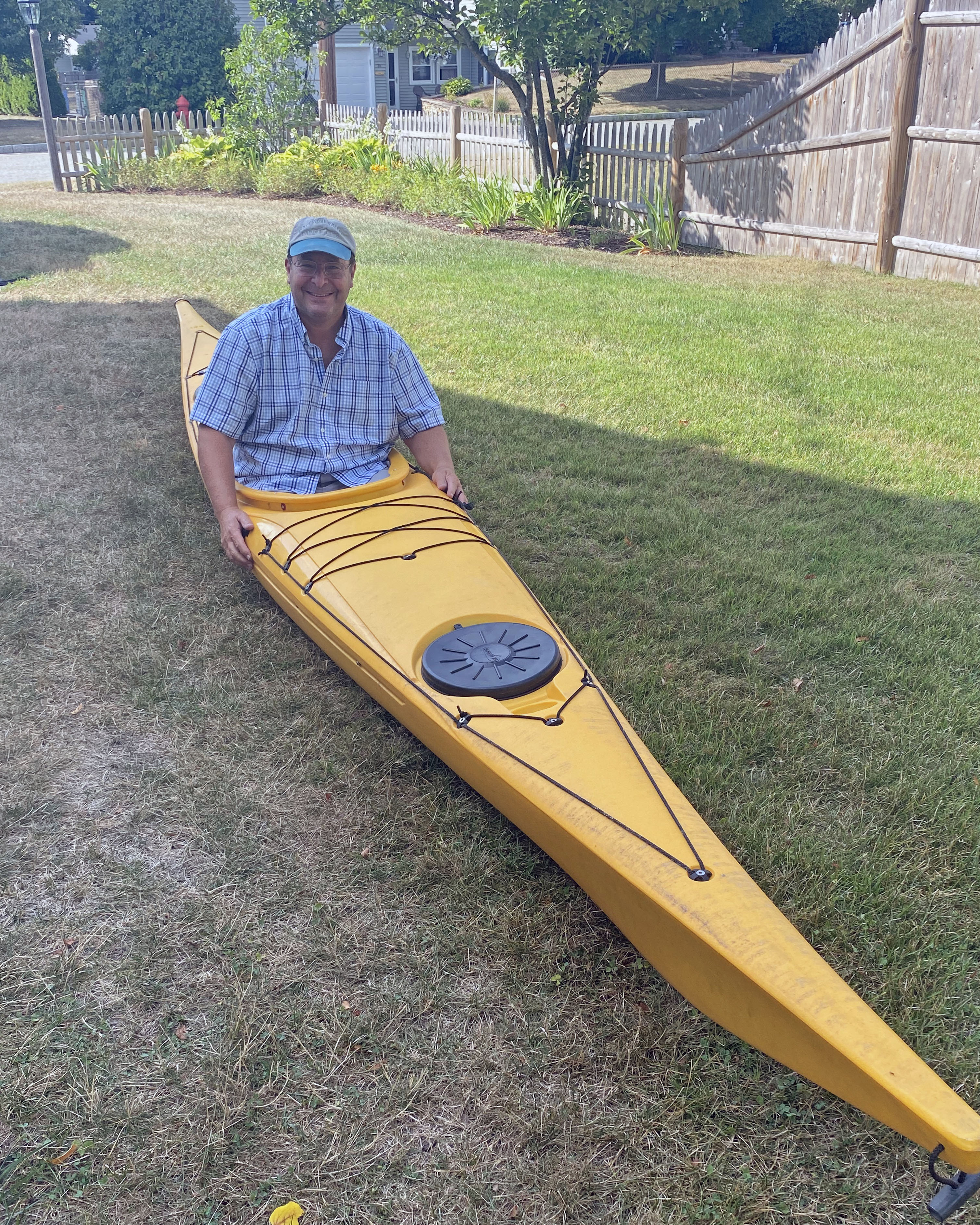
My spray skirt came in yesterday, so I asked Bill to spot for me at Lincoln Woods while I did some wet exits. It turns out that swimming out of a canoe for years is good practice for doing wet exits in a kayak. I did one without the skirt, one with the skirt, and popped out both times. Bill said that I was out of the boat so fast that I didn’t even get one side of my body wet. A bit of an exaggeration, but I was out fast and I don’t like being upside-down in the water. I need to work on that if I am ever going to learn to roll.

Me in my P&H Capella
We did a leisurely paddle around Olney Pond and I tried to practice some edging. I used Bill’s bow to figure out where the secondary stability was, and tried paddling some circles on an outside edge – it worked.  I was able to paddle circles with sweep and forward strokes.  Even without paddling, the boat was turning away from the side that I edged – pretty cool.  Definitely going to take some practice for me to get used to these outside edge turns, but I am beginning to see where the skill in sea kayaking comes from.

Wednesday, August 17, 2022

Lincoln Woods with the Capella - August 16, 2022

I got out for my first trip in the Capella, and I think I made a good choice with this boat. It is stable, picks up speed fast, and is more maneuverable than the Perception that I paddled at the kayak class. I tried some edging, and it responded best when edged to the outside of the turn. With the skeg down it tracked straight as an arrow. I set the paddle at 210 cm with 0º feather, just like at the kayak class. The toughest thing about this boat is getting in and out (fell out twice - one getting in and once getting out), and I still need to practice wet exits.

Me in the P&H Capella 166 RM

Monday, August 15, 2022

My new sea kayak - P&H Capella 166 RM

Home with the boat on the car
With an arthritic knee that has me sitting more than kneeling, I decided to pull the trigger and buy a sea kayak that will allow me to get out on the ocean. If I am going to sit anyway, why not enjoy Rhode Island's beautiful coast.

Looking for a boat was a bit overwhelming at first. In order to paddle with the RICKA sea kayak crew, I knew that I needed a sea kayak that was 15' or longer with front and rear bulkheads and perimeter lines. That still left a lot of boats. My size did limit things a little. I decided that I wanted a plastic boat that would be suitable as a day-tripper. If I could play around in the rocks, or use it to do some camping, that would be good as well.

Checking it out - I fit!
I ended up buying a 2004 P&H Capella 166 RM from Charles River Canoe & Kayak. This boat was introduced in 1996 and developed a reputation as one of the best plastic sea kayaks around. It is known as a mid-sized boat that turns and tracks well, and is suitable for "big guys". Spec’s for the Capella 166 RM are:
  • Length: 16’6”
  • Width: 22”
  • Depth: 14”
  • Rear hatch: 18” x 13”
  • Front hatch: 10”
  • Day hatch: 8”
  • Cockpit: 34” x 20", circumference 88" 
  • Material: rotationally molded polyethylene (RM)
  • Weight: 54 lbs.
Cockpit with new thigh braces
Once I decided on the boat, I needed to get a paddle. I wasn’t sure what I wanted, but figured I would go with Werner since that is the brand that I use in my canoes. I ended up with the adjustable version of the Shuna, that way I can play around with the length (200-220 cm) and feathering (0-45º). Once I figure out what I like, I’ll probably get a one piece paddle and use this as my spare.

Finding a skirt to fit this boat wasn’t easy either. The boat has a relatively large cockpit, and I have a relatively large belly. I knew that I wanted neoprene, so I ordered a base level bungee spray skirt – the Shockwave from Immersion Research. At some point, maybe I’ll get a custom order from Seals Skirts from Oak Orchard in New York.


2004 P&H Capella 166 RM
Links:

Sunday, August 14, 2022

Essential Kayak Skills class at the Kayak Centre - August 14, 2022

Strokes are demonstrated
I spent the day yesterday learning to paddle a kayak at the Essential Kayak Skills class at the Kayak Centre. It has been years since I’ve had any formal paddling instruction, and I really shouldn’t have waited this long.

This is an introductory course, so we spent a lot of time covering strokes – forward sweep, reverse sweep, 360 degree turn, forward stroke, reverse stroke, stopping, stern rudder, stern pry, beam draw and low brace. The focus was on shaft angle, (high, medium and low), good torso rotation, and paddle placement. Each stoke was demonstrated, and then we had individual coaching to make sure that we got it right.

Then we practice
After strokes, we covered wet exits and assisted/unassisted rescues. I did a T-Rescue as the rescuee and as the rescurer. A paddle float rescue was demonstrated, so I can try it sometime.

It was an excellent program and I am definitely glad that I did it. The trick will be to remember everything once I get my new boat out on the water. It also reminded me that I have gotten pretty sloppy in my open boat paddling - especially when it comes to torso rotation.  Too bad I didn't have my new boat yet.

Practicing assisted rescues
Links:

Thursday, August 11, 2022

If you could have a conversation with the Blackstone River, what would you say?

This question was asked as part of the Blackstone River Commons Anthology. My conversation with the Blackstone River would go something like this...

I wish I knew you when you were young. Not early in our history, but early in yours. More than 15,000-years ago when the glaciers retreated, the ice melted and raging waters cut through the rolling hills to create your valley. Today, you flow 48-miles and drop 450-feet on your way to the sea.

And you are not alone. Along the way you collect water from smaller rivers and streams like Mill Brook, the Middle, the Quinsigamond, the West, the Mumford, the Branch, the Mill, and the Peters. Your valley includes over 640 square-miles, and connects 39 communities in what is now Massachusetts and Rhode Island.

The glaciers left rolling hills and a wide floodplain in your valley. On higher ground oak forests grew, and in the low-lands blueberry bushes, willows, and alders thrived. Migratory birds flocked to your banks, and fish labored up your raging waters to spawn.

We often think about your history starting with the Europeans, but Native Americans knew you long before. For at least 9,000-years before the arrival of the Europeans, Native Americans came to hunt, fish and set up camps along your banks. They took advantage of your rich soil to grow crops, and your abundant supply of fish and wildlife.

That changed with the arrive of Europeans. By the middle of the 17th century, European settlers had established small farming communities in your valley. They took advantage of your abundant resources to grow crops, quarry minerals and harvest timber. They also built dams to power gristmills, sawmills and foundries. We started to change you.

With the development of the textile industry in the late-18th and early-19th centuries, industrialists took advantage of your steep drops and numerous falls to build water powered textile mills. Mill villages grew up along your banks with dams, mill ponds and eventually a canal and railroad.

We put you to work, and you earned the reputation of being the “birthplace of America’s Industrial Revolution” and “the hardest working river in America”. In the process, dams blocked the migration of fish, mill ponds collected harmful sentiments, and mills released dangerous chemicals. Little remained of your free-flowing waters.

By the middle of the 20th century the textile mills were gone, but the devastation they left in their wake remained. You were then known as one of the “most polluted rivers in America". But that didn’t stop us. We continued to dump sewage and other pollutants into your waters.

Fortunately, people now recognize the damage that has been done, and have begun to work on solutions. You became part of the National Heritage Corridor system in 1986, and were designated as an American Heritage River in 1998. Significant water quality improvements have been achieved as a result of the Clean Water Act and other pollution reduction initiatives, but we have a long way to go.

Through these efforts, many people now recognize your beauty, your grace and your charm. With a bike path along your banks, everyone can now see your potential. We continue to work to clean up your waters, return fish and other wildlife to your valley, and revitalize development along your banks in ecologically friendly ways.

You probably know all this, and have your own plan for the future. To you, we are just a spec in time. You have thousands of years to clean up the mess that we have made, and your waters will flow long after we are gone. Still, we need to do our part now to fix our mistakes, and hopefully we will.

Submitted as a reflection on the Blackstone River to the Blackstone River Commons Anthology - August 11, 2022.

Wednesday, August 10, 2022

Blackstone Gorge with the BVPC - August 10, 2002

I led a trip with Earl for the Blackstone Valley Paddle Club at the Blackstone Gorge. We paddled up past the Triad Bridge site to the old Millville Lock. We continued upstream, but the water was too shallow to get up to the Millville Rapids. Nice trip anyway.

Heading up the Blackstone River
Links:
My Pictures

Saturday, August 6, 2022

Fife Brook – August 6, 2022

Paul below Hangover Helper
It has been a while since I’ve been out in my whitewater boat, so I decided to test out my cranky knee and do a run with Paul on the Fife Brook Section of the Deerfield River.

I met Paul at McD’s for the ride up to Charlemont. After dropping him off at the put-in, I drove back to the take-out to drop off my car and catch a ride back in one of the shuttles. There were lots of groups getting organized, and I found an empty seat in a car with the CTAMC. It was Deerfieldfest weekend and the Dryway wasn’t running due to an issue with the dam, so there were crowds everywhere.  

Erik in Pinball
The Fife Brook Dam was releasing at 800 cfs – a medium low level. We put in at around 11:00 and began working our way downstream. The crowds at Hangover Helper and Carbis Bend were huge, but eventually we found some space to ourselves. We surfed the ledge below Freight Train and played in Pinball before taking a break for lunch at Miami Beach. We then ran the Island Rapid before heading down to Zoar Gap.

My record running the Gap is mixed - 15 attempts with 7 successful, 6 swims and 2 walks. I pulled over above the Gap to take some pictures before running it myself. Once in the Gap, I caught the eddy on the left below the first pour-over, and then went right of "Oh Shit Rock" though the second drop. It wasn’t pretty, but I made it. So my record in the Gap now stands at 16 attempts with 8 successful, 6 swims and 2 walks. My knee was fine.


Zoar Gap from Erik Eckilson on Vimeo.

Links: