Wednesday, January 6, 2021

Campfire Cooking

When I was in second grade my father took a job up in New Hampshire. We lived in a small apartment in the city of Dover, and spent most of the summer at a seasonal campsite nearby. I remember swimming in the lake and sitting around the campfire at night, but other than marshmallows and the occasional hot dog on a stick, cooking was always done on the camp stove. 

Omelets on the stove
When I started canoe camping the camp stove came with me. For some trips freeze-dried food cooked with a Jet Boil stove was the order of the day. For other trips we loaded up coolers with fresh food, but when I was the chef the cooking was always done on the camp stove.

For some of my friends, though, cooking in camp means cooking over an open fire. Jonathan is a good example. He will often look at the simple fire ring that is the staple at many campsites with a bit of disgust. If he is planning to cook on the fire, he will deconstruct old fire ring and rebuild it in a “U” shape about 8” to 10” tall and just wide enough to support the grill. 

Sausage and foil-pack potatoes
When a campfire cook has passed through a campsite you can always tell by the fire pit. The pit will be clear of ash and debris allowing ample room for wood under the grill. If it is round, it will be large with multiple cooking spots depending on the type of cooking to be done and the heat needed. Or like Jonathan’s, it will be “U” shaped.

I’ve leaned that a critical part of campfire cooking is having the right wood. Firewood should be collected selectively to leave the site and scenery as undisturbed as possible. Softwoods are usually the easiest to find and burn the fastest. Hardwoods produce a cleaner, longer lasting fire and better coals.  

Cooking on the Big Daddy
Anything you can cook on the stove you can cook on the fire, but it takes the right equipment and some patience. The most important part of the cooking fire is the height of the grill – too low and it will be tough to get wood underneath, too high and it will take a lot of wood to produce enough heat. A grill grate at 8” to 10” seems to work best. 

You will also need pots, pans and utensils. A good frying pan and large pot are essential for group meals. For cooking, keep the fire contained under the pots and pans. You will also need a knife, spatula, serving spoon and tongs. Long handles make it easy to work around the fire, and fireproof gloves are a nice addition.

Grilling salmon and vegetables
The type of fire that you build will depend on the type of cooking you are doing. Grilling directly over the fire requires a nice bed of hot coals, so get the fire going early or you might be eating late. Foil packs are an easy way to cook fish, potatoes and vegetables, but are also easier on a well-developed bed of coals. Be sure to turn the food often since hot spots can develop and burn the food if you are not careful. 

Cooking in pans is easier, and you can cook directly over the fire without having to wait for coals. Shift the pans around to get the heat that you need and prevent hot spots. Patience is still required since temperatures on the fire don’t match those generated on the stove. 

Dutch oven cooking
The dutch oven is one of my favorite ways to cook in camp. Anything you can cook in your oven at home you can cook in a dutch oven - frittata or cinnamon rolls for breakfast; enchiladas, lasagna or chicken and biscuits for dinner; monkey bread, brownies or dump cake for desert. The trick to cooking in a dutch oven is balancing the heat on the top and the bottom, and regulating the temperature. Regulating the temperature is much easier with charcoal than with coals from the fire, so I usually bring it long. 

No doubt about it, cooking is one of the joys of camping, and cooking over the open fire takes it to the next level.

Breakfast fire
Links:

Saturday, January 2, 2021

New Year's Day on the Upper Winni - January 1, 2021

Heading out
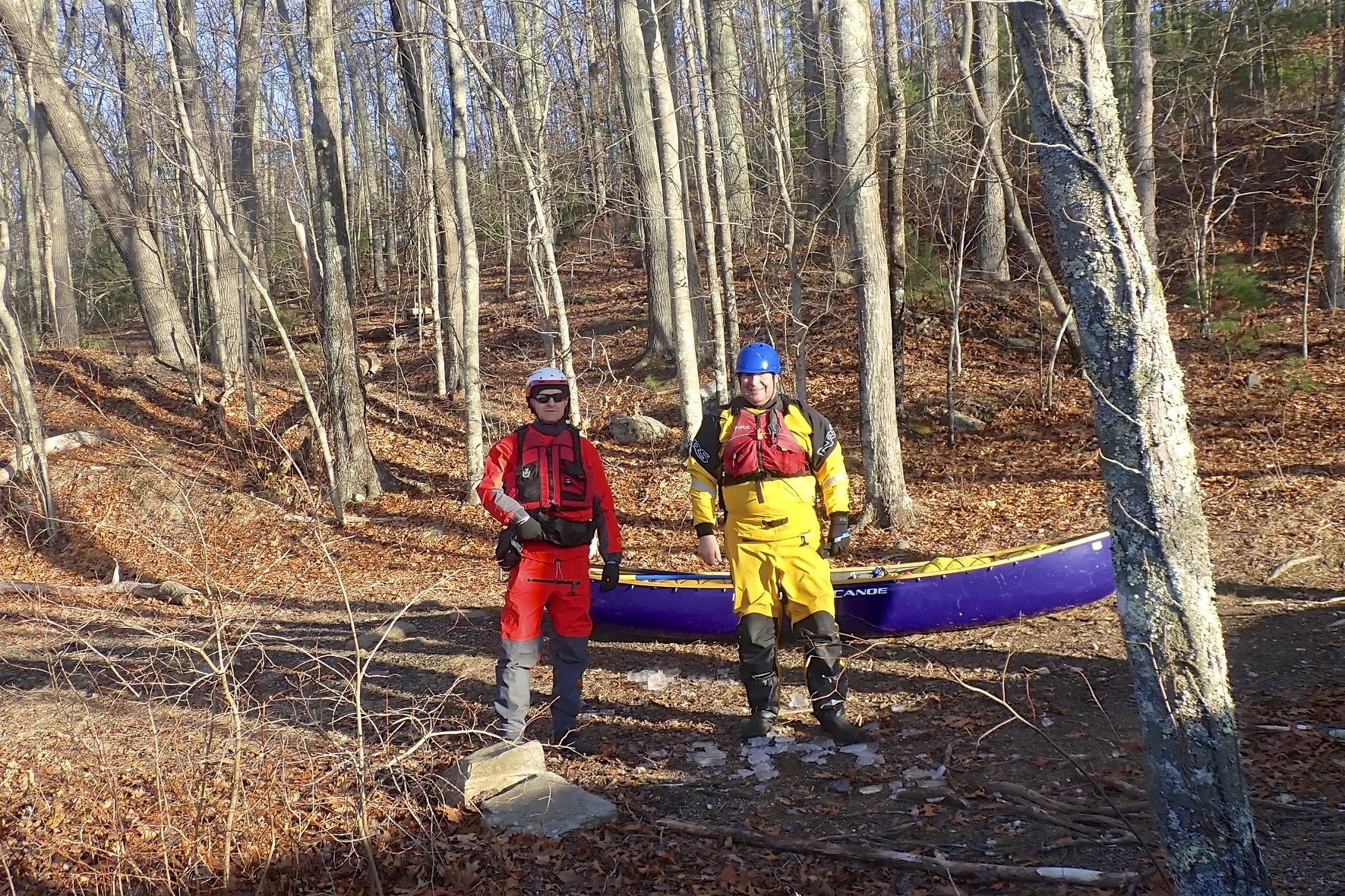
New Year’s Day trips are a tradition for many northeast boaters. The superstitious among us believe that in order to have a good paddling year you must be out on the water on New Year’s Day. I don’t take it that far, but I do try to get out on January 1st whenever I can. This year I decided to join Jonathan, Conrad, and Nancy for an Icicle Run on the Upper Winni.

The Winnipesaukee River (otherwise known as the Winni) is a 10-mile river that that runs from Lake Winnipesaukee to Franklin where it joins with the Pemigewasset River to form the Merrimack. There are two whitewater runs on the Winnipesaukee. The Upper Winni runs from Tilton Road to Riverfront Park in Tilton. It’s an easy class I/II run that is the site of an annual slalom race. I have run it many times in the past. The Lower Winni runs from Cross Mill Road Bridge to Trestle View Park in Franklin. Its a class III(+) run that is above my comfort level in my canoe, but I did it a few years ago with the MVP in a shredder.


Running Cribworks
With the annual New Year’s Day release the river was at a nice level – 4.4 feet, 1,100 cfs. We met at 10:30 at the Holiday Inn on Route 140 (the usual put-in was iced in) for the shuttle. Jonathan suggested that that we walk-shuttle the 2-miles from the take-out across from River Front Park (behind the train museum) on the Winnipesaukee River Trail, which runs parallel to Route 3 from a little above Tilton center to Route 140. It worked great, and we met the group at noon as planed.  

Canoes outnumbered kayaks on this trip with 5 canoes (Jonathan, Nancy, John, Ken and Erik) and one kayak (Conrad). The river starts off with quickwater along Route I-93. The first railroad bridge starts the slalom course through First Trestle and Cribworks, followed by Second Trestle and waves below the School Street Bridge. It took us two hours to do the run, playing as we went.


The crew takes a socially distanced break
Links:

History of the New Year’s Day Paddle on the Lower Winni by Ken Norton

Skip Church asked me to give a history of the New Year’s Day Paddle on the Winnipesaukee River - here’s what I know….

With the potential for the end of whitewater paddling on the lower Winnipesaukee River on the horizon, the first formal New Year’s Day paddle began on January 1, 1998. Local developers, under the name Franklin Hydroelectric, had filed with the Federal Energy Regulatory Commission (FERC)in 1992 to study construction of a new hydro dam on the lower Winni (project no 11281-000). The proposed 150 foot long and 22-foot-high dam was to be located on the Franklin/Tilton town line just downstream of the bridge on Cross Mill Road. The proposal also included a 12-foot (later increased to 14 foot) diameter penstock running ¾ of a mile downstream to a hydro generating plant just above the Trestle in Franklin. The penstock would effectively dewater the river. Under the organizational name Friends of the Winnipesaukee River, I filed a motion to intervene with FERC on Behalf of the Merrimack Valley Paddlers (MVP), the Central Canoe and Kayak Club, Belknap County Sportsman Association, Basil Woods Chapter of Trout Unlimited, and Ducks unlimited.

In 1988, Friends of the Winnipesaukee River had previously intervened with FERC on a similar proposal on the lower Winni (project #10476-000). It is interesting to note that the Merrimack Valley Paddlers had declined to be included as an intervenor in that proposal stating the Lower Winni was “rarely” used by MVP members and due to it being “trashy (rebar debris etc.).” The Appalachian Mountain Club (AMC) also declined. From a historical perspective, the Winnipesaukee River carried raw sewage and was not considered a recreational resource until the completion of the Winnipesaukee River Basin project around 1980. The project laid sewer lines from Meredith/Center Harbor to Franklin and included newly constructed sewage treatment plants in Laconia and Franklin. With deference to the Abenaki and Penacook people who traversed the Winnipesaukee River for centuries, the first known modern day whitewater descent of the Lower Winni (I’m sure there were previous ones) took place around 1983/4 and included a cohort of NH’s best paddlers: Sonny Hunt, Mark Ciborowski, Brad Helfer, John Aldridge, Bill Zeller, and Jim Sindelar. (They were mostly canoers - WW kayaking was only starting to take off. The Perception Dancer which popularized and revolutionized the sport, came out in 1982) . Rebar poked a hole in Jim’s boat, and word soon spread in the paddling community to avoid the Lower Winni. However, seeing the potential for a great white water run, they returned armed with portable sawzalls and began removing rebar, dam remnants, trees, trash and other obstacles. Other paddlers including also took up the cause. But I diverge from the story…..

Unlike the previous dam proposals on the Lower Winni (there were 3 others in the past decade), this proposal had a high likelihood of moving forward. The developers were local and had constructed the Clement Dam in Tilton several years earlier. They had the engineering skills, knowledge of the Winnipesaukee River, and financial backing to pull it off. They had also been filing required reports with FERC and making progress on their proposal.

In an effort to foster mutual interests of paddlers and hydro producers, Friends of the Winnipesaukee had previously partnered with these developers on Earth Day events including tours of the Clement Dam. Based on that relationship, the developer agreed to a meeting at Cross Mill Road with myself Representing Friends of the Winnipesaukee River, and George May from the MVP to discuss their proposal and concerns of the paddling community and other interested parties. The meeting was sobering; the developer drove off leaving George and I standing on the bridge talking about the seriousness of the threat, the lack of any common interests between the proposed dam and paddling, and brainstorming strategies for how to generate more public opposition to the dam proposal. Solutions identified included having a high visibility New Year’s Day paddle which would increase the awareness and interests of recreational opportunities on the Lower Winni and engage local stakeholders in promoting those efforts and opposing the dam proposal.

Running the Winni on New Year's Day wasn’t entirely a new thing, the River Rats, a group of folks from the Lakeport area, had been doing it off and on in tubes, during the 80’s. Fred Zimmerman, one of the River Rats, had taken up whitewater paddling and Fred had invited a few kayakers to join the River Rats on one of their New Years’ Day runs in the late 80’s. It should be noted that cold weather gear then was pretty limited. Dry suits were relatively new and few paddlers had them. When I paddled with Fred and the River Rats on one of those runs, we had farmer john wetsuits and wore nylon shells/jackets over them. Fred wore Playtex gloves which he duct taped to his wrists. I wore nylon ski over-mitts. The following year Fred enticed a few more paddlers by offering lunch afterwards. He was a good cook and served shells stuffed with Ricotta and pieces of Italian sausage. His apartment in Northfield was tiny and could only seat two people at a time. There were only a few intrepid paddlers those first couple of years, and we would have a beer out in the parking lot and take turns going up to Fred’s apartment for lunch.

What was envisioned was building on this informal tradition by formalizing it. We would attract more paddlers by renting a hall/offering a warm place to change, and serving lunch afterward. We would encourage spectators by publicizing it, and doing it at a set time, not the old “MVP time” of whenever everyone finally showed up. And we would engage the media by issuing press releases, offering interview and quotes, and by changing the narrative from focusing on wild people paddling in the cold to people paddling in the cold for a cause - opposing the dam and promoting the Lower Winnipesaukee as a recreational resource.

The first year was a big success with about 30 paddlers and great media coverage locally, statewide and throughout New England. The MVP rented the Masonic Hall in Tilton, and Fred cooked for everyone. Momentum and coverage built over the next few years with less experienced paddlers doing the Upper Winni. We made a big splash in 2000, when we capitalized on the Y2K hysteria by hosting a Y2Kayak New Year’s Day Event. In subsequent years, Hall rental moved from Tilton to Franklin and Nancy Gero (and John) took over cooking/hosting duties. The MVP gave annual awards to local people who helped promote recreation on the Winnipesaukee River. With paddlers returning to paddle the Lower Winni throughout the year, the Franklin community began to embrace the event and the role recreation could play in Franklin’s rebirth. Toward that end, the economic development group Choose Franklin adopted the event as First Day Franklin and began setting up a warming tent for spectators and paddlers.

Another threat to whitewater paddling on the Lower Winni was safe take-out access. The takeout was the parking lot of The Silver Bullet, a nefarious Franklin bar. It was a Class III+ take out which included a poor eddy line, lots and lots of broken glass, and a crumbling 10 foot brick wall between the river and parking lot, which involved passing boats up over the wall and climbing a broken ladder to get out – or trying to climb the ladder with your boat. The bar burned down and the lot was put up for sale. Had it been sold and the river fenced or blocked off, it would have essentially ended paddling the Lower Winni as there were no alternative take outs. Having watched the growing numbers of paddlers, and with encouragement from the Winnipesaukee River Trail Association (WRTA), the Grevior family bought the land, put it into conservation easement for perpetuity, and worked with the WRTA, the City of Franklin, the National Park Service and others to create Trestle View Park which opened in 2005.

Faced with growing opposition and construction costs, uncertainties about electric utility regulation, and a city that was now embracing whitewater paddling and river recreation as a driver of economic development, plans for hydro development of this section of river were dropped. With the success of using the New Year’s Day paddle to highlight opposition to a hydro project which would have dewatered the Winnipesaukee River, the annual New Year’s Day Paddle has been used to raise awareness of other important issues including construction of the Winnipesaukee River Trail, and Trestle View Park, inclusion of a take-out ramp at Riverfront Park in Tilton (2006), proposed summer whitewater releases, and most recently construction of Mill City Park and New England’s first whitewater park. Whether a paddler, or spectator, come on out and join the fun on New Years’ Day!

Newspaper article from the Laconia Citizen on the 1998 run

Thursday, December 31, 2020

2020 Year End Review

New Years on the West River
Well, this was a year like no other. My paddling year started on New Year's Day with a flatwater trip on the West River, and ended the Sunday after Christmas with a whitewater trip on the Branch River. In between it was a year of challenges and loss, but we kept moving forward in spite of COVD-19.  

My paddling and hiking was unaffected by COVID in January and February, but then it hit. The first COVID-19 cases in MA were reported in February when a Biogen Leadership Conference became a super spreader event. I was at the gym in early March when I heard about the first COVID-19 cases in RI from a Saint Raphael Academy trip to Italy. Shortly after that a stay-at-home order was issued, I was working from home, and things would never be the same.  


With Paul on the Branch
For the rest of March and April I followed the stay-at-home order and paddled alone and close to home – River Island Park, Manville and Lonsdale. I did do a Branch River trip with Paul in April with Michelle providing the shuttle. Once the stay-at-home order was lifted in May, I kept my circle small and paddled mostly no-shuttle, flatwater trips with Bill, Conrad, Al and Jonathan - Nashua, Charles, and Concord.

It wasn’t until July that I started paddling group trips again, but I was still careful about car shuttles. I only did one car shuttle all year – the Magalloway, and only after both Conrad and I were tested.  On the positive side, I did do a few bike shuttles (Blackstone - Lonsdale to Manville, Lower Deerfield, Charles – Medfield to Dover, Tville, Narrow River, Pawcatuck - Burlingame to Potter Hill, Quabaug, Assabet – Acton to Concord, Nashua – Ayer to Groton), and that works great. 


Lifetime Membership Award
I led my first RICKA trip on Point Judith/Potter Pond in July. After that I led Bradford to Potter Hill in August, Wickford in September and Tully Lake in October. I was honored with RICKA’s Lifetime Membership Award, which was hand delivered by Bill at the bike path at Rivers Edge Park.

The year ended with my father’s passing after a long illness. I did my first canoe trip with my father in 1989 on the Albion to Manville section of Blackstone, and my first whitewater trip with him in 1990 on the Androscoggin River. I went back to paddle the Blackstone on the day of his passing as a tribute to him. It was cold and gray, and somehow it didn’t fill the hole in my heart the way that I expected. I’m sure in the days and years ahead I will miss him in many ways that I never expected.  


1990 on the Androscoggin River
I did 56 trips, which is slightly less than my 11-year average of 58 trips.  Without being able to shuttle, I did a lot less whitewater and had only one swim - the Lower Deerfield. Here are some of my more significant trips:

Here are some of my favorite trips for the year.


I paddled almost every day of my summer vacation in South County, including the trip on the Narrow River and the RICKA trip on Point Judith and Potter Pond.


Our spring camping trip to the Allagash got cancelled, but I did get out for a fall camping trip with Conrad and Julie. We paddled the Magalloway River down to Lake Umbagog, across Lake Umbagog to the Rapid River, and then back across Lake Umbagog and down the Androscoggin to Errol. The weather was perfect and the foliage was peak.

Fall Camping in NH and ME from Erik Eckilson on Vimeo.


The crew at Noon Hill
I got out for a few hikes with the Papa Joe hiking group before the hikes got cancelled in March, and again when they started up again in the fall.

In terms of my resolutions from last year, I didn’t do so well. I didn’t take a paddling class and I didn’t get back to the Dead. At least I got in one camping trip. In terms of resolutions for next year, they are a lot like last year with one BIG difference.

  • Get the vaccine as soon as it is available
  • Take a class III paddling class – especially with my new boat
  • Get back to the Dead – always a great trip
  • Keep camping – I’d really like to do the St. Croix
  • Practice rolling – I’ll keep including it until I do it

Fortunately, there are still plenty of rivers to paddle, plenty of trails to hike, and plenty of places to go camping. Happy New Year everyone.

Sunday, December 27, 2020

Branch River - December 27, 2020

Harrisville Dam
With the 2"-3" of rain that we received on Christmas Eve and Christmas Day all the rivers were running this weekend. With family obligations and my self-imposed limitation on car-shuttles, though, my options were limited. The Branch was up, it's close to home, Paul was available, and Michelle was willing to run the shuttle for me, so the Branch it was.

The Branch River technically arises in Oakland at the confluence of the Clear and Chepachet Rivers. From there it flows east for approximately 10-miles through Slatersville and Foresdale to its convergence with the Blackstone River in North Smithfield. 


Whipple Drop
The first half of this trip is actually on the Clear River. The Clear River arises in the swamps southeast of Wallum Lake in Burrillville and flows generally east for approximately 10-miles through Pascoag and Harrisville before converging with the Chepachet River in Oakland to form the Branch. The Nipmuc is a major tributary of the Clear River, converging with the Clear in Harrisville above the dam.  

We met at the put-in below the Stillwater Mill at 12:30 and were on the river around 1:00. The river rose to 7.5', 2,000 cfs on Saturday, but was down to a more reasonable level of 4.75', 650 cfs on Sunday – still the highest level that I have paddled it. The day was sunny and warm, at least in the early afternoon when the sun was high.


Oakland Dam
We paddled the short distance up to the Harrisville Dam before heading downstream. We hit a couple of river-wide blow-downs above Whipple Drop that we had to portage. I ran the Whipple drop to the right avoiding the rocks and big hole in the center. I did a little surfing below Whipple Drop, once again avoiding the biggest wave in the middle, before heading downstream.

There was one blow-down between Whipple Drop and Oakland that I decided to portage. Paul was able to work his way through on the left. When we arrived, I was glad to see water flowing over the Oakland Dam. Last time we were here the dam was high and dry with all the water flowing through the old Oakland Mill and down the raceway. A big log now blocks water from flowing though the gate into the mill, but it was unclear whether this was random piece of debris or was placed there intentionally.  


Atlas Pallet
After portaging the Oakland Dam we did a little surfing below the dam before heading down to Glendale. The Glendale Rapid was big and fluffy, and I ran it to the left, once again avoiding the big rocks in the middle. From there it is a nice quickwater run down to Atlas Pallet. I ran Atlas Pallet to the left and made it through fine. Paul went a little more to the right, and hit some rocks on the way down. After a little surfing below the rapid we headed downstream.

From there, it is quickwater with one portage at the Nasonville Dam. As the sun was setting the temperature dropped and my feet were starting to get cold. I was glad to see my car sitting at the take out.


Oakland Dam Portage

Links:

My Pictures

Branch River Gage

River description from American Whitewater

Sunday, December 20, 2020

I lost my bow paddler today - December 20, 2020

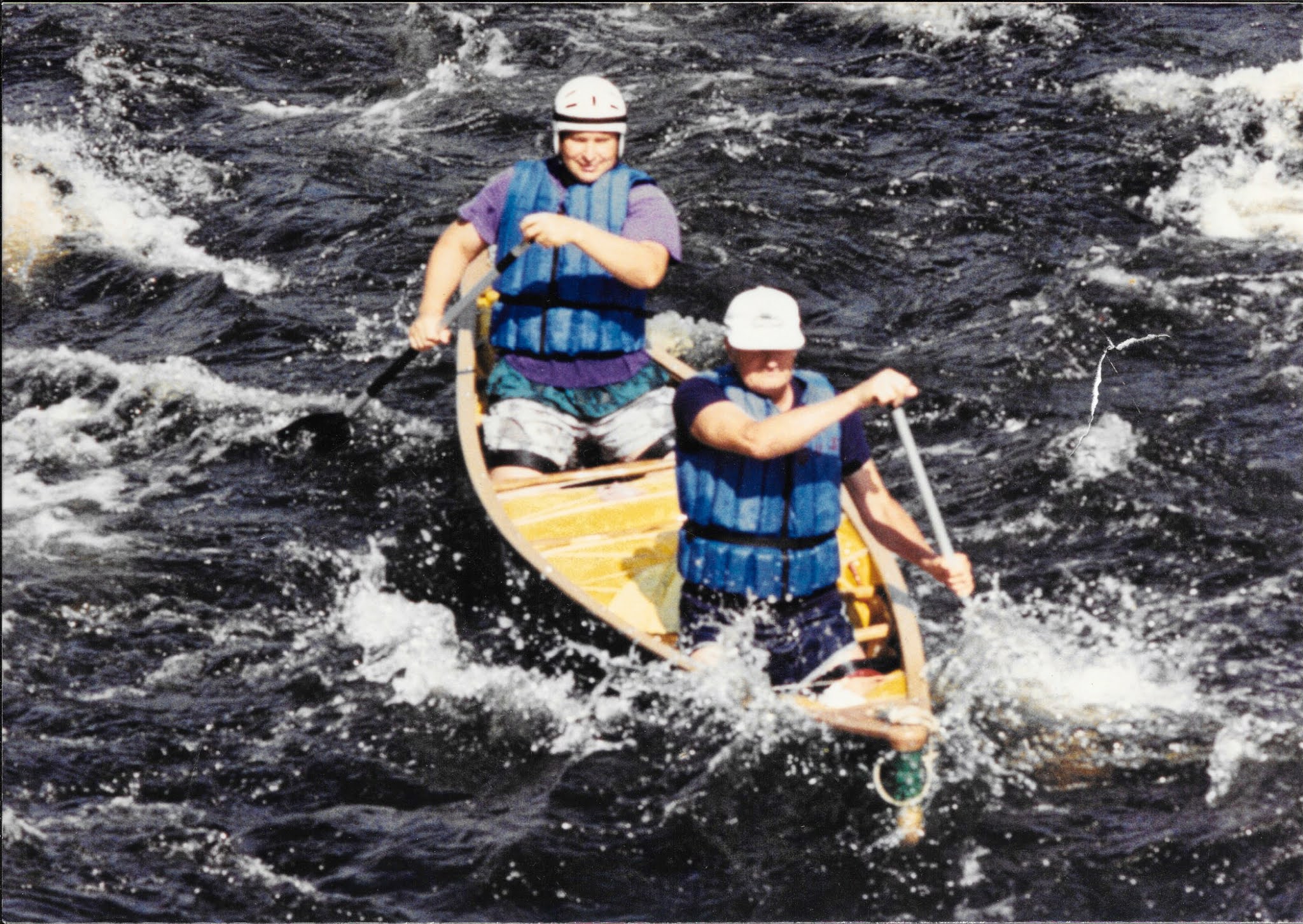
I lost my bow paddler today, or maybe I should say my stern paddler because he was always in the background ready to execute the perfect correction stroke to keep me on track. My father – Gustav W. Eckilson (Ecky to his friends and Welton to his family) passed away on December 20, 2020 after a long illness. He is absolutely responsible for my addiction to paddling, and it is one of the many, many things that I thank him for every day.


As a young man my father was an active outdoorsman and mountain climber. In 1962 he reached the peak of Mount Rainier – one of the most challenging mountain summits in North America, and a frequent training ground for Everest climbers. Arthritis and a young family ended his outdoor activities for a while, but they resumed in retirement when he enjoyed hiking, camping and canoeing, mostly with the Narragansett Chapter of the AMC.


I did my first canoe trip with my father in 1989 on the Albion to Manville section of Blackstone in the Spirit II, and my first whitewater trip in 1990 below the Pontook Dam on the Androscoggin River in the Mohawk. I still paddle both of those boats regularly today. Unfortunately, my young family limited my ability to paddle with him when he was most active. By the time I caught the paddling bug around 2006, his arthritis had returned and he was out of the boat and off the trail. He would ask about my adventures, but we were never able to go on a trip together.  


I went out today to paddle on the Blackstone as a tribute to him. It was cold and gray, and somehow it didn’t fill the hole in my heart in the way that I expected. I’m sure in the days and years ahead I will miss him in many ways that I never expected.  


Rest in peace Dad – no one deserves in more than you.


Paddling the Errol Rips on the Agroscocggin River in 1990

Monday, December 7, 2020

Noon Hill and Shattuck Reservations – December 6, 2020

View from Noon Hill
I was thinking of doing a Crystal run, but the long drive and the late start meant that it would be an all-day event.
 The Papa Joe hike was close to home at the Noon Hill and Shattuck Reservations, so I decided to go there instead. 


Noon Hill is a 204-acre Trustee’s property located in Medfield and centered on 370-foot Noon Hill, a prominent summit and scenic vista. Noon Hill is part of a larger area of protected open space including land owned by the town of Medfield and the Shattuck Reservation located to the northwest of Noon Hill along the Charles River.


Along the Charles River
We met at the trailhead is near Holt Pond, which was created around 1764 when Sawmill Brook was dammed to create a millpond. In the 19th century, after farmers cleared the forest, the land surrounding the pond became stonewall-enclosed pasture. Woods have since reclaimed these fields.

We had crunchy snow underfoot as we headed west out of the parking lot toward Noon Hill. From there we headed north and then west across Causeway Street to the Shuttuck Reservation and a trail along the Charles River. 


Links